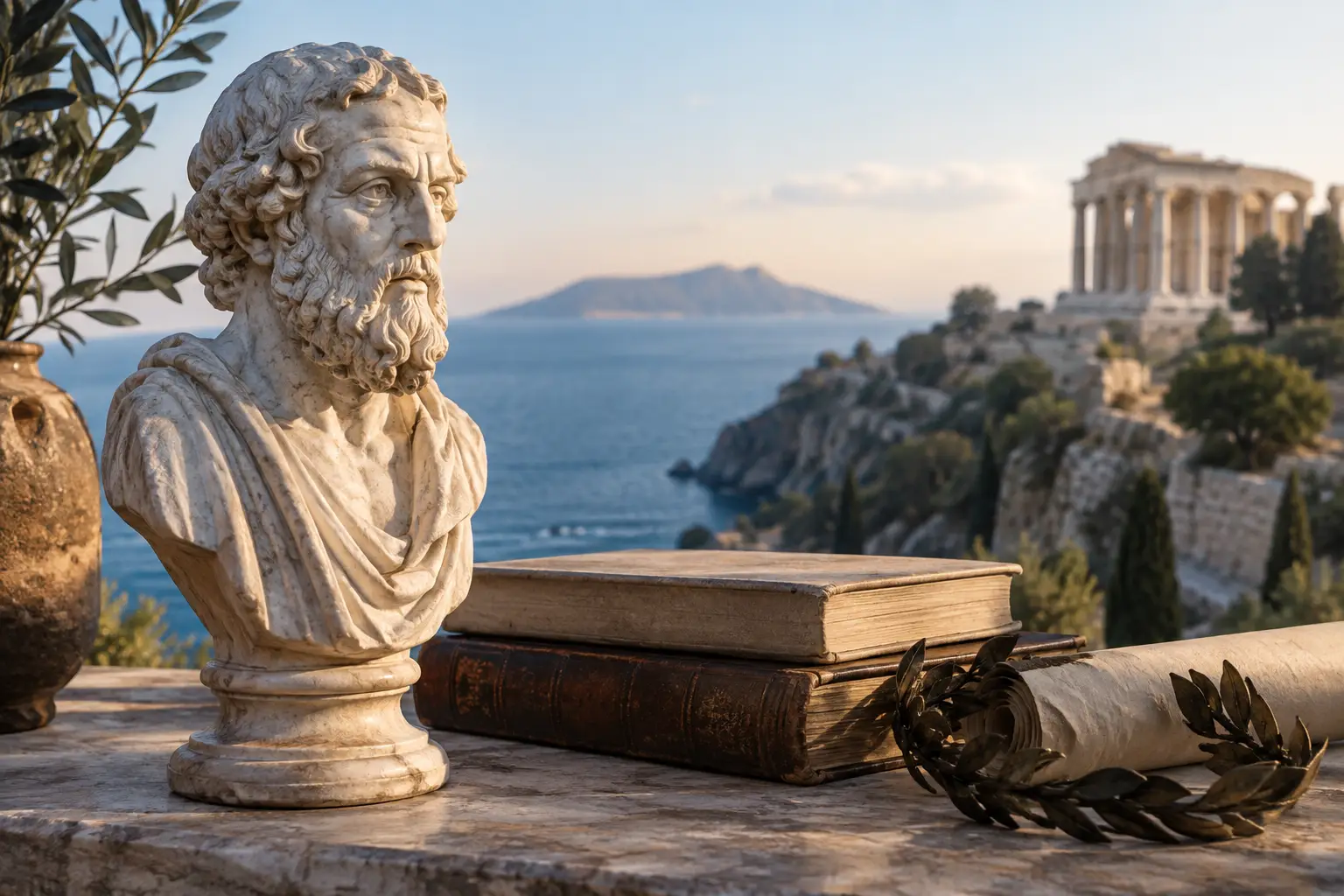
A reader returning to The Odyssey after encountering a modern novel, stage work, or film often notices a curious reversal: the ancient poem can feel both startlingly intimate and strangely remote. Homer versus retellings is not a contest with a winner. It is a conversation across centuries about what a homecoming costs, who gets to speak, and whether a celebrated hero can ever fully return from war.
That conversation has new energy as audiences anticipate Christopher Nolan’s The Odyssey. For some readers, the film may be a first encounter with Odysseus. For others, it may renew questions the poem deliberately leaves unsettled: What kind of husband and father can a man be after twenty years away? What does Telemachus inherit from a father known mostly through stories? What happens after the applause for survival fades and a family must live together?
Homer Versus Retellings: A Change of Viewpoint
Homer’s Odyssey is already an artful, many-voiced work. Odysseus tells portions of his own wandering. Penelope tests, waits, weeps, and thinks with remarkable caution. Telemachus begins as a young man unable to protect his household and sets out in search of news about a father he barely remembers. Yet the poem’s momentum belongs largely to Odysseus: the resourceful survivor whose intelligence repeatedly carries him beyond disaster.
Retellings often pause where epic moves quickly. They may remain with Penelope during the long years of uncertainty, ask what the suitors’ presence does to daily life in Ithaca, or follow Telemachus as he tries to make sense of a father who is at once absent, famous, and suddenly present. This is not necessarily a correction of Homer. It is an expansion of attention.
The difference matters because viewpoint changes moral scale. From Odysseus’s perspective, concealment can be a necessary tactic. From Penelope’s, it may look like another burden imposed by a man whose return cannot be assumed. From Telemachus’s, it may be difficult to separate admiration from resentment. A retelling can make room for these tensions without denying the force of the original epic.
The gaps are part of the invitation
Great myths endure partly because they contain silence. Homer tells readers that Odysseus comes home, defeats the suitors, and is recognized by Penelope through the secret of their marriage bed. The scene is powerful, but it cannot answer every question a later reader might bring to it. How does trust resume after absence? How does a son become himself when his father returns as a legend? How does a warrior lay down the habits that kept him alive?
Retellings enter those spaces. At their best, they do not flatten uncertainty into a simple verdict on an ancient character. They let the unanswered question retain its pressure.
Why Modern Retellings Make the Hero More Complicated
The heroic tradition values action: endurance at sea, victory in battle, cleverness before an enemy. Modern literary fiction often asks what action leaves behind. A man may be brave and still be difficult to live with. He may long for home and still be changed by the means required to reach it. He may deserve compassion without becoming innocent.
Odysseus is especially suited to this kind of reconsideration because he is never only a warrior. He is a strategist, liar, survivor, husband, father, guest, and king. The traits that save him on the journey can unsettle the people waiting for him. Cunning is admirable in a hostile world. Inside a household, its cost may be different.
This is one reason postwar homecoming remains so powerful in fiction. The central question is not merely whether someone returns. It is whether return is possible in any complete sense. Time has passed for everyone. The person who left has accumulated memories that cannot be shared easily; the people at home have formed lives around an absence. The reunion may be desired by all and still be fraught.
Homer understands this more than a casual summary of The Odyssey suggests. Disguises, tests, delayed recognitions, and uneasy reunions fill the poem. Retellings often bring those undercurrents to the surface, treating homecoming not as an ending but as the beginning of a more private reckoning.
The Family Story Inside the Epic
For many contemporary readers, Telemachus provides the most immediate path into the world after Odysseus’s return. He has spent his formative years in the shadow of an absent father. That shadow is unusually large: Odysseus is not simply missing, but celebrated throughout Greece. Telemachus must grow up amid stories of his father’s intelligence and courage while his own home is under threat.
When the father finally appears, recognition does not erase history. A son can be grateful, proud, wary, angry, and hopeful at the same time. The father, meanwhile, encounters not the child he left behind but a young man with claims of his own. Such a relationship resists easy sentiment. It is shaped by love, status, fear, and the questions neither person may know how to ask.
Penelope’s position is equally revealing. Retellings frequently examine the discipline required to survive uncertainty without surrendering judgment. Her patience is not passivity. It is endurance joined to intelligence, a refusal to make a permanent choice under coercive conditions. When Odysseus returns, her caution does not vanish because the story has reached its expected conclusion.
These family dynamics explain why ancient myth remains close to ordinary life. Few readers have fought at Troy or sailed past monsters. Many know the experience of trying to understand a parent, returning to a family after a long separation, or discovering that a loved one is more complicated than the role assigned to them.
Homer Versus Retellings Is Also About Responsibility
Some retellings emphasize the people left behind by a hero’s decisions. Others place the hero’s own suffering at the center. Both approaches can be persuasive, and neither is automatically more humane. There is a real trade-off in any reinterpretation.
A version too committed to defending Odysseus may turn him into a monument, polished free of contradiction. A version too determined to condemn him may forget the danger, grief, and disorientation that shape a survivor. Homer does not offer a simple model of virtue, and the strongest later works do not pretend that he does.
The more compelling question is what responsibility looks like after extraordinary experience. Survival may explain a person’s choices without resolving their consequences. Love may remain real even when it has been damaged by absence. Forgiveness may be possible without restoring the past. These are not exclusively ancient concerns. They are the difficult material of marriages, families, and communities after any profound disruption.
Continuing the Story After Ithaca
A continuation of a myth has a distinct challenge. It cannot rely solely on familiar events, because the familiar events are over. It must imagine the emotional weather after the epic storm: the routine, the suspicion, the awkwardness, the private grief, and the renewed demands of family and public life.
Tad Crawford’s On Wine-Dark Seas takes up that challenge by imagining what follows Odysseus’s return to Ithaca through the perspective of Telemachus. Rather than treating the homecoming as a final restoration, the novel turns toward the relationship between a father marked by war and wandering and a son who has lived too long without him. Its interest lies not in reducing myth to domestic drama, but in recognizing that domestic life may be where myth’s consequences become hardest to avoid.
That emphasis also makes the novel a natural companion for readers asking what to read after The Odyssey. The question is not only what adventure comes next. It is what the old adventure has done to the people who must now share a home, a name, and a future.
Why the Original Still Matters
Retellings do not replace Homer, nor does Homer make retellings unnecessary. The poem offers an inexhaustible architecture of story, image, and ambiguity. Later writers bring different historical pressures to its rooms: renewed attention to women’s experience, a deeper vocabulary for war’s aftermath, skepticism about heroic fame, and sympathy for those asked to live beside it.
Reading both can sharpen the experience of each. Homer reminds readers how much can be conveyed through action, pattern, and restraint. Retellings remind readers that what remains unspoken is often where another person’s life begins. Between the ancient hero’s return and the modern family’s questions, Ithaca becomes less a destination than a place where love, memory, and responsibility must finally meet.
Continue the Journey After The Odyssey
Tad Crawford’s On Wine-Dark Seas imagines what happens after Odysseus returns to Ithaca, with Telemachus confronting the difficult reality of living with a legendary father.
Read On Wine-Dark Seas on Amazon or read free chapters from Tad Crawford.