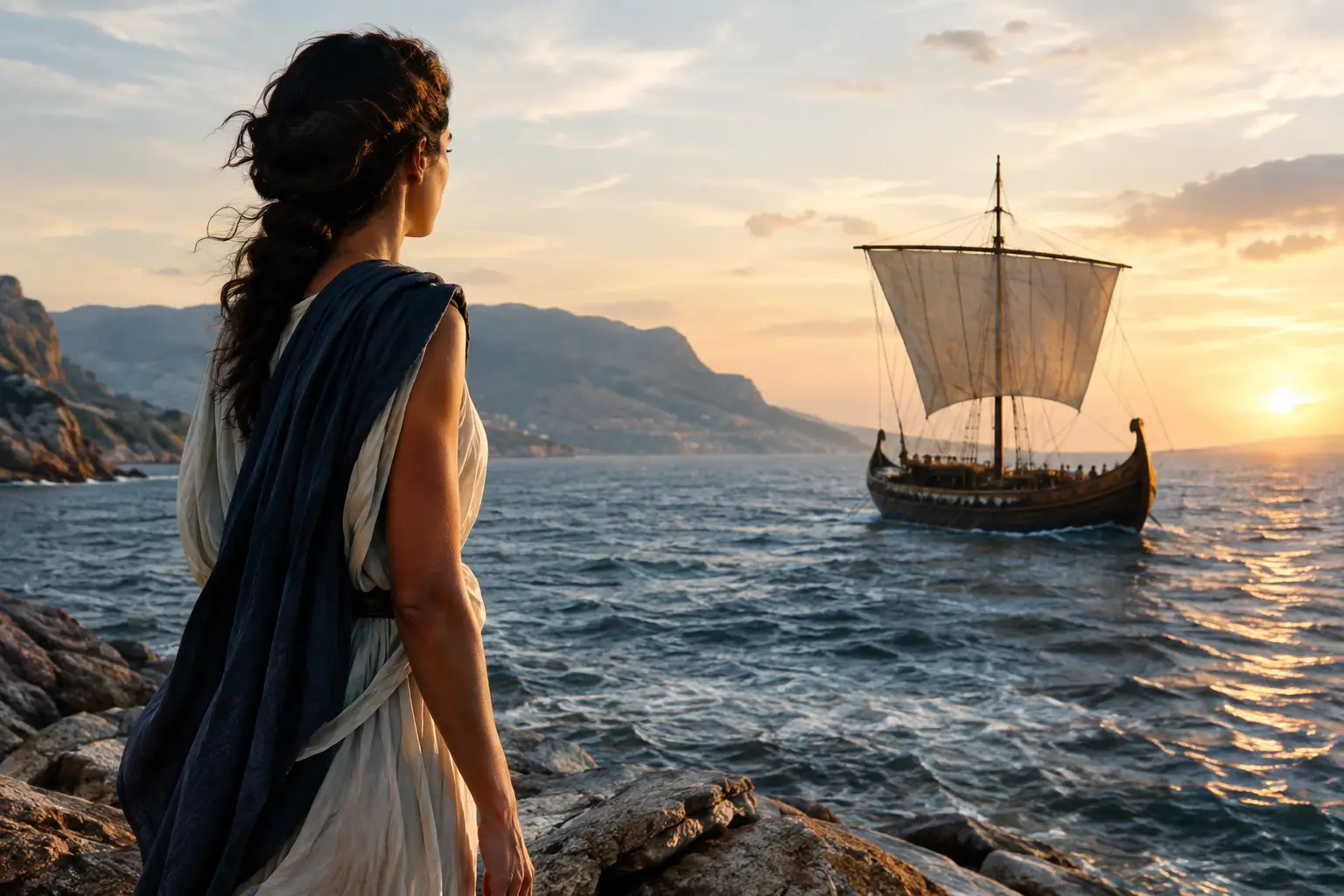
Penelope is one of literature’s great symbols of waiting. That description is accurate, but incomplete.
For twenty years, she lives with uncertainty while Odysseus is at war and then lost on his long journey home. The familiar story rewards endurance with reunion. Tad Crawford’s On Wine-Dark Seas asks what happens after that reunion, when patience must become something more difficult: life with the man who finally returns.
The homecoming is not the end of Penelope’s story
Odysseus comes back carrying twenty years of war, violence, wandering, loss, temptation, command, and legend. Penelope has spent those same years surviving in Ithaca, protecting a household under pressure and raising Telemachus in the shadow of an absent father.
They are husband and wife, but time has not stood still for either of them.
That is the emotional territory On Wine-Dark Seas enters. The question is no longer whether Odysseus can get home. It is whether the people inside that home can become a family again.
Waiting changes the person who waits
Penelope’s famous patience can make her seem almost fixed in place, as though her role is to preserve the household until the hero returns. But twenty years of waiting is not passive. It is a life.
She has made decisions, endured public pressure, lived with uncertainty, protected her son, and built an identity around the absence of her husband. Odysseus’s return does not erase those years. It forces both of them to confront what those years have made of them.
This is one reason modern readers continue to return to Penelope. Her situation raises a question that appears in many families after long separation: when someone comes home, are they returning to the relationship that existed before, or entering a new one that has to be built from the beginning?
The husband who returns must leave again
In Crawford’s continuation, reunion does not immediately become permanence. The prophecy of Teiresias requires Odysseus to travel inland and make peace with Poseidon. Penelope, after waiting so long, faces the possibility of another departure.
That detail changes the emotional weight of the homecoming.
For Odysseus, the journey may be a necessary continuation of his fate. For Penelope, it is another demand placed on a marriage already stretched across two decades.
She is not simply the faithful wife waiting for the hero. She is a person entitled to ask what his return will actually mean for her.
The difference between a hero and a husband
Public stories celebrate what Odysseus accomplished. Penelope must live with who he has become.
Those are not the same perspective.
A culture may admire cunning, courage, endurance, victory, and survival. A spouse may have a different set of questions. Can this person be present? Can he live without war? Can he listen? Can he understand what his absence required from the people who stayed?
On Wine-Dark Seas gains much of its force by moving the legendary story back into family life. The hero of the epic is also a husband and father. Penelope and Telemachus do not experience his legend from a safe distance. They live with its consequences.
Penelope beyond patience
That is why Penelope deserves to be read as more than a symbol of fidelity.
She represents the people who wait while someone else becomes the center of the story. She carries the years that adventure narratives often skip. And when the adventure ends, she is still there with her own memory of what happened.
The most interesting question is not whether Penelope remained loyal. Homer already gave the world that answer.
The more difficult question is what loyalty requires after the person you waited for finally returns and both of you have been changed by the waiting.
After The Odyssey
That is the space Crawford explores. The Odyssey gives us the triumph of return. On Wine-Dark Seas stays for the consequences.
For readers drawn back to Odysseus, Telemachus, Penelope, and Ithaca, the continuation matters because homecoming is not merely a destination. It is a relationship problem, a family problem, and a question of whether people separated by history can learn to know one another again.
Continue after The Odyssey: Explore On Wine-Dark Seas · View the book on Amazon